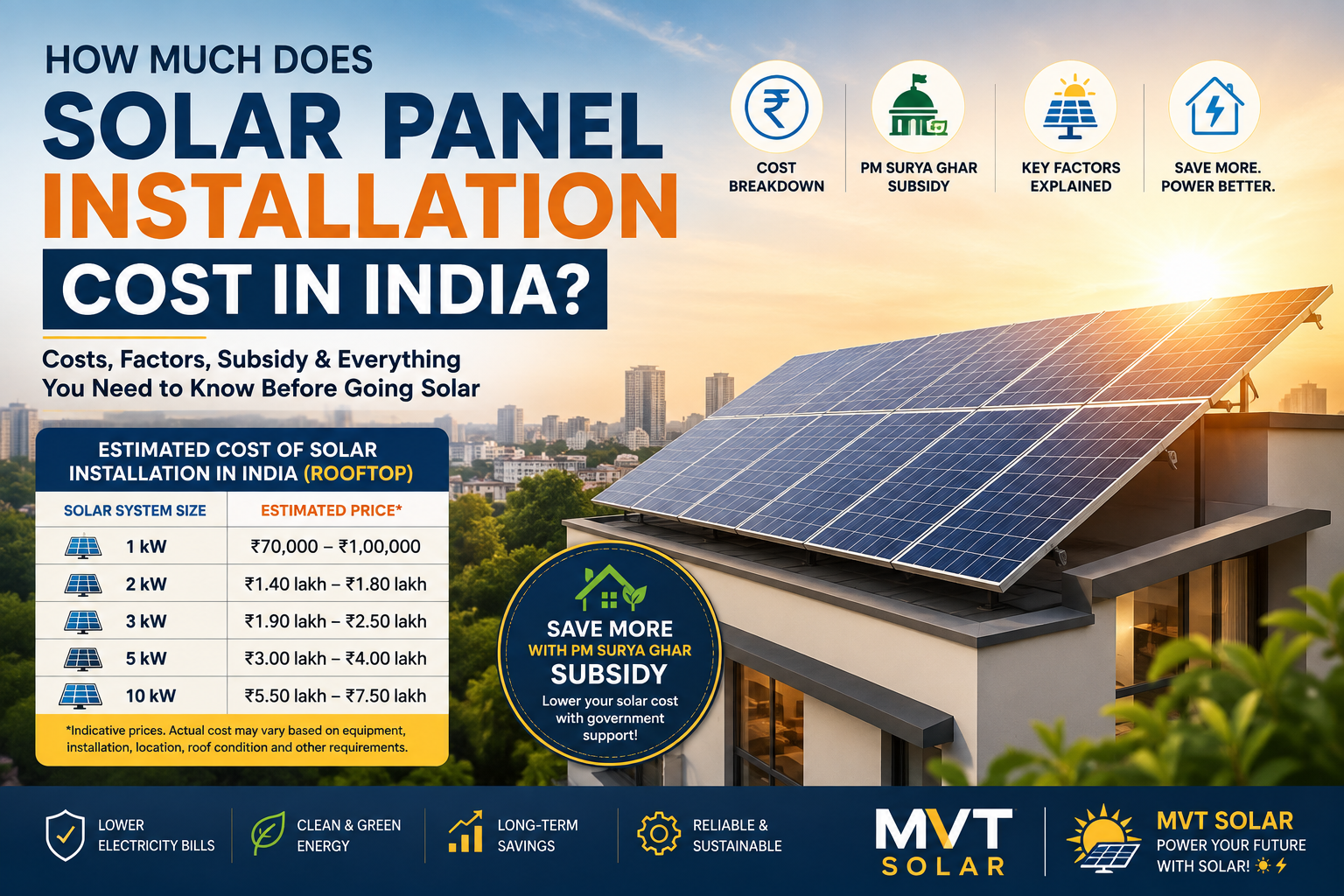
How Much Does Solar Panel Installation Cost in India?
If you are going to install solar panels at your home or office, one of the primary things you would be curious about is “What is the cost of installing solar panels in India?”
There are various factors responsible for determining this amount, like size of solar panel system, type of solar installation, quality of solar panel and inverter, need for installation and availability of government subsidy.
For residents, installing a rooftop solar system could be an excellent decision, as it not only reduces their electricity bill but also enables them to generate power from the roof of their house.
Let us get acquainted with the key factors determining solar panel installation cost in India and what you should know before going ahead with your solar installation service provider.
What Is the Cost of Solar Panel Installation in India?
The price is not static in regard to a solar installation because the power needs of each property differ along with the nature of its installation.
As a broad market estimate, an installation of a solar system at a domestic rooftop would be something like:
Solar System Size
Estimated Price of Installation*
1 kW
₹70,000 – ₹1,00,000
2 kW
₹1.40 lakh – ₹1.80 lakh
3 kW
₹1.90 lakh – ₹2.50 lakh
5 kW
₹3.00 lakh – ₹4.00 lakh
10 kW
₹5.50 lakh – ₹7.50 lakh
These are just indicative prices that might change according to the nature of equipment, installation structure, inverter, roof condition, geographical location, configuration of the system and other needs of the project.
What Does a Solar Installation Cost Include?
While getting a quotation for your roof from the professional solar energy provider, the quotation will involve more than simply the solar panels.
The rooftop solar energy system includes:
- Solar PV panels
- Solar inverter
- Mounting structure
- DC and AC cables
- Protection devices
- Earthing and lightning protection
- Installation and commissioning
- Monitoring system
- Net-metering related support, where applicable
- Transportation and other installation requirements
It depends on what type of solar energy system you would like to have.
How Much Does a 3 kW Solar System Cost?
One of the widely used solar systems is the 3 kW system in residential homes.
Considering the type of equipment and the installation process, a 3 kW rooftop solar system will cost about ₹1.9 to ₹2.5 lakh prior to subsidies.
The actual price might vary depending on the following factors:
- Solar panel brand and technology
- Inverter capacity and brand
- Roof structure
- Installation height
- Cable length
- Mounting structure
- Electrical modifications
- Net-metering requirements
- Additional battery backup requirements
If there is an appropriate consumption of electricity and proper roof space, then such a system can help in reducing dependency on the grid electricity.
How Does the PM Surya Ghar Subsidy Reduce Solar Cost?
For residential consumers who qualify, the PM Surya Ghar: Muft Bijli Yojana scheme gives Central Financial Assistance (CFA) for rooftop solar.
Under this scheme, financial assistance is available for the first 2 kW and the extra part of the third kW, and there is no more central subsidy beyond 3 kW for the residential category. The subsidy depends on the cost set by the government. (Solar Rooftop)
Therefore, you can actually save a lot of money on your eligible residential installation compared to its original price.
It is necessary, however, that you check whether you are entitled to any subsidy and go through all the installation procedures according to the relevant government guidelines and DISCOM procedures.
What Factors Affect Solar Panel Installation Cost?
1. Solar System Capacity
The more extensive the solar system, the higher the initial costs involved.
For instance, 5 kW will require many panels, large inverter capacity and more installation supplies compared to 2 kW.
A system with the correct capacity should be installed by considering your electricity needs, available roof area and your future power demands.
2. Solar System Type
Three popular options include:
On-grid solar system:
Connected to the electricity supply system and ideal for lowering electricity expenses.
Off-grid solar system:
Operates using batteries to store the solar energy and helpful in regions without reliable electricity supply.
Hybrid Solar:
Combines solar power generation, grid and batteries.
Batteries can increase the cost of the whole process; hence off-grid and hybrid solar systems might cost more than on-grid solar systems.
3. Solar Panel Quality
These are the most important parts of your system.
Better quality panels provide better performance, durability and reliability. It is advisable to check the module standards and eligibility that apply to your project if it is an under government scheme or net metering project. The ALMM list from MNRE contains models and manufacturers that are eligible for government assisted projects and net metering projects. (Ministry of New and Renewable Energy)
4. Inverter
Inverter converts the electricity produced by the solar panels to usable electricity in your premises.
Selection of appropriate inverter is essential for performance and reliability of the system.
5. Roof Condition and Installation Structure
Installation needs vary for different roofs.
The cost depends on:
Type of roof (RCC/Sheet)
Height of the roof
Accessibility of the roof
Mounting structure required
Orientation of the roof and shadow free roof area
Distance of cable routing
6. Battery Backup
If you wish to have power backup during power cuts, you require a battery based system.
Cost structure of on-grid and hybrid/off grid systems differ drastically due to batteries.
Is Solar Panel Installation Worth the Investment?
Solar can be considered as an investment over a long period of time rather than just an expense for houses or businesses.
After installing the solar system, the panels will provide you with electricity for decades to come, thus lowering your dependency on grid electricity.
The cost-saving depends on several criteria:
- Current electricity consumption
- Electricity tariff
- Solar system size
- Solar generation
- Installation cost
- Subsidy eligibility
- System maintenance
- Future electricity tariff changes
A professional solar firm can estimate the production and possible savings from your electricity bill.
How Much Roof Space Is Required for Solar?
The amount of roof space needed is dependent upon the panel type used and the system size.
As a rough guideline, 1 kW capacity of the rooftop solar power plant can require roughly 80–100 sq. ft. of unshaded roof space, though the actual requirement may vary based on the size of the panels and installation technique used.
Prior to installing a solar power plant, the following need to be considered about the roof:
- Adequate sunlight
- Shading from trees or buildings
- Structural suitability
- Available installation area
- Safe access for installation and maintenance
How to Choose the Right Solar Installation Company?
Selecting the most inexpensive quotation may not be the wisest decision.
Before opting for a solar company, ensure that:
✔ Experience
It is necessary that the company has sufficient experience with regard to solar installations in both domestic and business sectors.
✔ Quality Products
You need to inquire about the quality of solar panels, inverters, mounting hardware and protection devices offered by the company.
✔ Quality of Installation
Quality installation is very important for the safety and proper working of the system.
✔ Net-Metering Facility
In case you are going for an on-grid system, inquire about the facility of net-metering provided by the company.
✔ Post-Sale Assistance
Solar systems are investments for the future. Make sure the company offers good customer support in terms of maintenance and assistance.
✔ Proper Quotation
The quotation must contain the details regarding the capacity of the system, equipment, installation, warranty and other charges.
Why Choose MVT Solar?
At MVT Solar, we deliver tailor-made solar solutions tailored to your needs regarding the power of electricity you need and your premises.
Through consultation, selection of system, installation, net-metering, and after-sales services, our experts will facilitate your transition to solar energy.
We provide the following services:
- ☀️ On-Grid Solar Systems
- 🔋 Off-Grid Solar Systems
- ⚡ Hybrid Solar Systems
- 🏠 Rooftop Solar Installation
- 🔧 Installation & Maintenance
- 📋 Net-Metering Support
- 🛠️ After-Sales Service
With a wide range of experience in the solar energy industry and a special emphasis on high-quality installation and customer support services, MVT Solar guides you through better energy choices.
Final Thoughts
And now, how much does it cost to install solar panels in India?
Depending upon the size of the system, its cost may vary from a few tens of thousands to a few lakhs of rupees. There can be more savings as far as the government subsidy goes if you are eligible for it.
While selecting the solar system, avoid considering it solely on the basis of cost. Concentrate on the quality of the system, proper sizing, installation, warranty, subsidy and service after-sales.
The best solar system is not always the most economical one, but it should always be designed with consideration of your electricity consumption.
Ready for Going Solar?
Would like to get to know about how much will it cost for your house or industry?
Get in touch with MVT Solar for a customized solar assessment and quote.
MVT Solar – Power Your Future with Solar! ☀️⚡
Comments