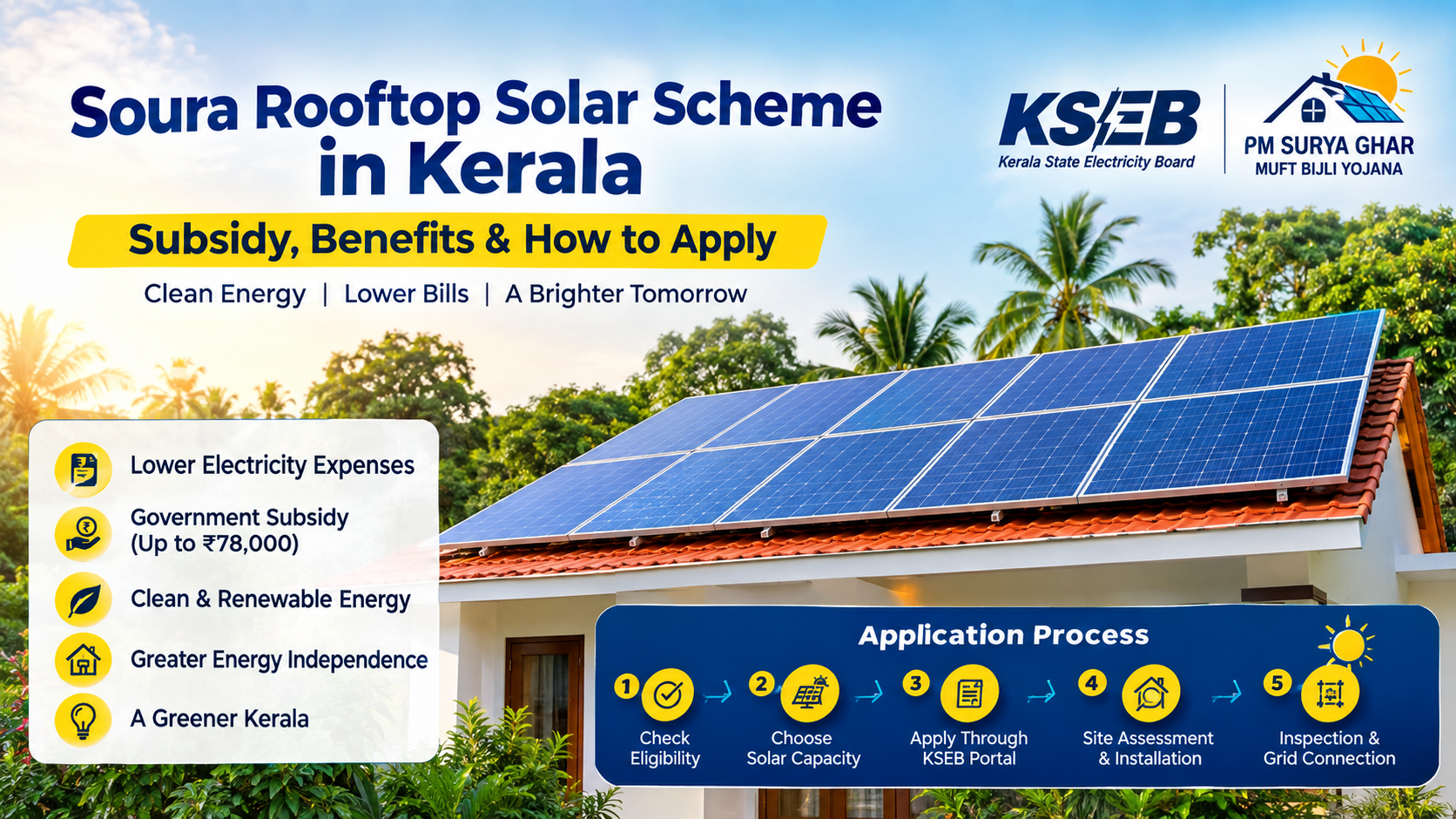
Soura Rooftop Solar Scheme in Kerala: Subsidy, Benefits & How to Apply
Kerala is rapidly moving towards clean and renewable energy, and rooftop solar is becoming an increasingly popular choice for homes across the state. With rising electricity expenses and government support for residential solar installations, installing a solar power system can be a smart long-term investment.
For consumers in Kerala, the Soura rooftop solar programme and KSEB's solar rooftop portal play an important role in connecting consumers, solar developers and the electricity distribution system. Today, eligible residential consumers can also benefit from the PM Surya Ghar: Muft Bijli Yojana, the central government's rooftop solar subsidy programme.
If you are planning to install solar panels at your home in Kerala, understanding the scheme, subsidy, application process and benefits can help you make the right decision.
What is the Soura Rooftop Solar Scheme?
Soura is Kerala's rooftop solar initiative associated with KSEB, designed to encourage the installation of grid-connected rooftop solar photovoltaic systems.
KSEB's Solar Rooftop Portal provides a unified platform through which consumers can access rooftop-solar information, select developers and submit applications for interconnection. It also helps consumers track the application process.
The objective is simple:
Generate clean electricity from your own rooftop, reduce dependence on conventional electricity and lower your monthly power expenses.
What is PM Surya Ghar and How Does It Relate to Kerala?
One important point to understand is that Soura and PM Surya Ghar are not exactly the same scheme.
The Soura programme is associated with Kerala's rooftop solar implementation through KSEB, while PM Surya Ghar: Muft Bijli Yojana is the central government's residential rooftop solar programme.
Under the current central subsidy structure, residential consumers can receive Central Financial Assistance (CFA) based on the installed solar capacity.
For eligible residential installations:
For example, a qualifying 3 kW residential rooftop solar installation can receive a maximum central subsidy of ₹78,000.
Note: Subsidy eligibility, application requirements and programme conditions can change. Consumers should always verify the latest requirements through the official KSEB and PM Surya Ghar portals before making an installation decision.
Who Can Benefit from Rooftop Solar?
Rooftop solar is particularly useful for residential electricity consumers who have:
The exact solar capacity required depends on your electricity consumption, available rooftop area and other technical factors.
KSEB's E-Kiran portal also provides a calculator where consumers can enter their consumer number and available shadow-free rooftop area to estimate a suitable plant capacity.
How Much Rooftop Space Is Required?
The space required depends on the capacity and type of solar panels used.
As a general planning estimate, a 1 kW rooftop solar system may require around 80–100 square feet of usable shadow-free area.
However, the actual requirement can vary depending on:
A professional site assessment is therefore recommended before finalising the system capacity.
How Does a Rooftop Solar System Work?
A typical on-grid rooftop solar system works through a simple process:
1. Solar panels generate electricity
Solar panels installed on the rooftop convert sunlight into DC electricity.
2. Inverter converts the power
The solar inverter converts the generated DC electricity into AC electricity that can be used by household appliances.
3. Your home uses solar power
The electricity generated by the system is first used to power appliances in the home.
4. Excess electricity can be exported
When the solar system produces more electricity than the home is consuming, the excess may be exported to the grid according to the applicable KSEB regulations and metering arrangement.
5. Electricity is monitored through the meter
The applicable metering system records electricity import and export according to the approved regulations.
This allows a properly designed rooftop solar system to reduce the amount of electricity a household needs to purchase from the grid.
What Are the Main Benefits of Rooftop Solar in Kerala?
Lower Electricity Expenses
One of the biggest reasons homeowners choose solar is to reduce their dependence on grid electricity and manage their long-term power expenses.
Government Subsidy
Eligible residential consumers can benefit from the applicable PM Surya Ghar subsidy, which can significantly reduce the initial investment for a qualifying system.
Clean & Renewable Energy
Solar power uses sunlight to generate electricity without the direct combustion of fossil fuels during generation.
Long-Term Investment
A properly installed and maintained solar system can continue generating electricity for many years, making rooftop solar a long-term energy investment.
Increased Energy Independence
Generating electricity on your own rooftop can reduce your dependence on electricity purchased entirely from the grid.
What Is the Application Process?
The rooftop solar application process generally involves several stages.
- Check Your Eligibility
Check your electricity connection, rooftop suitability and eligibility for the applicable subsidy programme. - Select the Appropriate Solar Capacity
The required capacity should be decided based on your electricity consumption, rooftop area and future requirements. - Apply Through the Appropriate Portal
KSEB's Solar Rooftop Portal provides a platform for rooftop solar applications and interconnection-related processes. - Site Assessment
The rooftop is assessed to determine factors such as available space, shading, structure and installation requirements. - Installation
After the necessary approvals and arrangements, the selected solar developer installs the rooftop solar system. - Inspection, Metering & Grid Connection
The system goes through the applicable testing, inspection and interconnection process before being connected to the grid.
KSEB's rooftop solar system outlines stages including consumer application, developer site acceptance, technical feasibility, installation, testing and net-meter connection.
Why Choose MVT Solar for Your Rooftop Solar Installation?
Choosing the right solar company is just as important as choosing the right solar system.
At MVT Solar, we help customers choose solar solutions based on their actual electricity requirements, rooftop conditions and budget.
Our services include:
With quality products, professional installation and reliable after-sales support, MVT Solar aims to make the transition to solar simpler for homeowners across Kerala.
Is Rooftop Solar Worth It for Your Home?
For many Kerala households, rooftop solar can be an excellent long-term investment—especially when the system is correctly sized and installed on a suitable rooftop.
Instead of looking at solar simply as another household expense, think of it as an investment in generating your own electricity for years to come.
With government support, increasing awareness of renewable energy and the potential to reduce grid electricity consumption, now is a great time to explore whether rooftop solar is right for your home.
Planning to Install Solar in Kerala?
Not sure whether you need a 2 kW, 3 kW, 5 kW or larger system?
MVT Solar can help you understand your electricity requirements, evaluate your rooftop and choose a suitable solar solution.
Switch to solar. Reduce your electricity dependence. Power your home with clean energy.
MVT Solar – Your Solar Partner in Kerala
Contact MVT Solar today for a rooftop solar consultation and find the right solar solution for your home.
Keywords: Soura Rooftop Solar Scheme Kerala, Solar Subsidy Kerala, Rooftop Solar Kerala, PM Surya Ghar Kerala, KSEB Solar, Solar Panel Kerala, Solar Installation Kerala, Best Solar Company in Kerala, Residential Solar Kerala, Solar Subsidy Kerala 2026
Comments